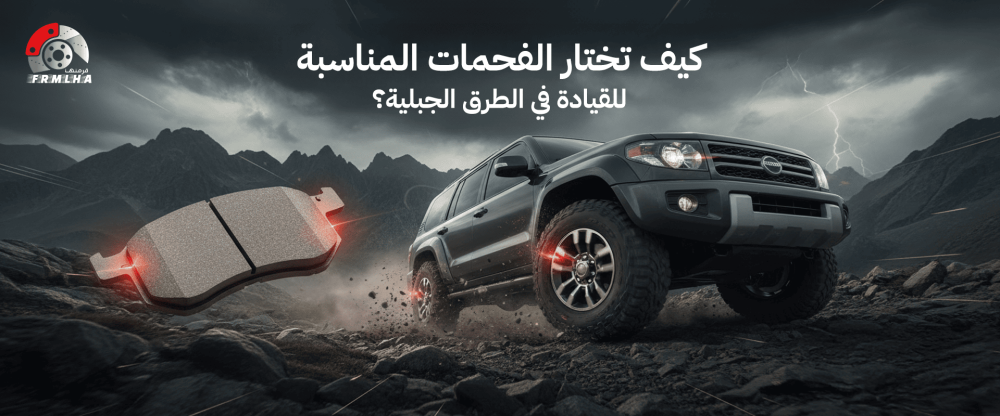
If you're a fan of mountain road travel and adventure, you know that driving on steep inclines and slopes isn't just a fun experience; it's a responsibility that requires equipping your car with the best parts to ensure complete safety and precise control. Among the most important of these parts are brake pads , which play a crucial role in braking power and vehicle stability, especially when descending long inclines or encountering sudden turns.
In our brakes section , we help you choose the right brake pads for your driving style, and we provide you with a comprehensive guide that gives you a deeper understanding and helps you make the right purchase decision that lasts a long time and provides you with real value.
Why are mountain roads a real test for coal?
Mountain roads are completely different from driving in cities or on highways; they require higher braking power because:
- Long inclines that increase frictional pressure.
- The need for frequent braking.
- The hopper temperature is high.
- Sudden changes in the speed and direction of the car
This is where brake pads come in , balancing performance and withstanding high temperatures. Choosing the right brake pads for mountain driving isn't a luxury; it's a necessity to avoid reduced braking efficiency, unpleasant noises, or even rapid wear that could damage your car's rotors. If you're planning a mountain trip, be aware that using weak or unsuitable brake pads can wear out faster than expected and may compromise your ability to stop safely on descents, making the selection of the right type a matter that cannot be postponed.
What are the specifications of brake pads suitable for mountain driving?
When considering purchasing ideal brake pads for driving in mountainous areas, there are a number of criteria that will help you differentiate between good and average quality:
1. High heat resistance:
Continuous friction during braking on hills generates a lot of heat, so the brake pads must withstand high temperatures without losing their efficiency or emitting unpleasant burning smells.
2. Manufacturing material:
The best mountain brake pads are made from semi-metallic materials, high-quality ceramics, and concentrated wear-resistant compounds. These materials provide consistent performance and a longer lifespan, especially under heavy braking.
3. Stability of force during repeated braking:
When descending a mountain, the brakes don't stop working. Therefore, the brake pads must maintain their performance even after prolonged use, without losing stopping power.
4. Reduces wear on car brake rotors:
Poor-quality brake pads can cause scratches or wear on your car's rotors, leading to unnecessary repairs. Choose good quality pads that protect the rotor surface and provide smooth, effortless braking.
How do you choose the right brake pads according to your driving style?
Choosing brake pads depends not only on the type of road, but also on your driving style:
- Fast or semi-sporty driving: If you drive on the mountain at higher speeds or on winding roads, you need brake pads with: strong grip, high thermal resistance, and consistent performance at speeds. These types are usually used in cars with larger engines or those that travel a lot in difficult environments.
- Quiet and balanced driving: If you prefer quiet driving and use the brakes wisely, you can choose high-quality ceramic brake pads, as they: emit less dust, have a longer lifespan, and are quieter.
- Driving with a family or extra weight: When climbing mountains in a loaded vehicle, the brakes are under increased strain. Therefore, you need strong brake pads that can withstand: the vehicle's weight, higher temperatures, and repeated braking during descents.
Signs that tell you the current brake pads are not suitable for mountain roads:
Before you begin your trip to Taif, Abha, Al-Baha, or any mountainous region, make sure your car's brake pads are in excellent condition. Here are the main signs that tell you it's time to replace them:
- A clear whistling sound when pressing the brakes: this means they are badly worn or are no longer able to make proper contact with the rotors.
- Noticeable vibration during braking: The vibration of the car while descending is evidence of a problem with the car's brake pads or rotors, and both parts should be checked together.
- A smell of heat or burning after a long descent: this is a sign that your car's brake pads are not suitable for the mountains and cannot withstand high temperatures.
- Poor brake response or increased stopping distance: these are among the most dangerous signs that should not be ignored.
When should car brake pads be changed before mountain trips?
It is advisable to check them before every long trip, especially if they are:
- It has been more than 6 months since it was installed.
- They were used on busy roads within cities.
- Any of the above signs appeared.
The test takes no more than a few minutes and saves you from many risks.
How does its braking help you choose the right brake pads?
At our Framlha store , we provide you with:
- Multiple types of car brake pads suitable for mountain roads.
- High-quality ceramic carbon brushes .
- Carbons that withstand heat and loads.
- Genuine and guaranteed products.
- Competitive prices and fast shipping.
Conclusion:
Choosing the right brake pads for mountain roads isn't just a purchasing decision; it's a crucial step to ensure your safety and the safety of your passengers while driving. Mountainous terrain demands higher braking power and consistent performance under pressure and heat, and that's precisely what high-quality brake pads provide.
Don't wait for problems to arise; prepare now by equipping your car with durable brake pads that will last longer and give you complete confidence when descending slopes. With these brakes , you'll always be ready for any road, even the most challenging.